Let Us Sing of His Love Once Again Hymn Lyrics
 Cover of the 1863 sheet music for the "Battle Hymn of the Republic" | |
| Lyrics | Julia Ward Howe, 1861 |
|---|---|
| Music | William Steffe, 1856; bundled by James E. Greenleaf, C. Due south. Hall, and C. B. Marsh, 1861 |
| Audio sample | |
| "The Battle Hymn of the Republic" as performed by the The states Air Force Band
| |
The "Battle Hymn of the Republic", also known as "Mine Eyes Have Seen the Glory" exterior of the United States, is a popular American patriotic vocal by the abolitionist author Julia Ward Howe.
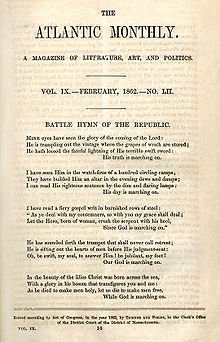
Howe wrote her lyrics to the music of the song "John Brown's Trunk" in Nov 1861 and first published them in The Atlantic Monthly in February 1862. The vocal links the judgment of the wicked at the end of the age (through allusions to biblical passages such equally Isaiah 63:1–half dozen and Revelation xiv:14–19) with the American Civil War.
History [edit]
Oh! Brothers [edit]
The "Glory, Hallelujah" melody was a folk hymn developed in the oral hymn tradition of campsite meetings in the southern United states and beginning documented in the early 1800s. In the get-go known version, "Canaan's Happy Shore," the text includes the verse "Oh! Brothers will you meet me (3×)/On Canaan's happy shore?"[1] : 21 and chorus "At that place we'll shout and give Him glory (three×)/For glory is His own."[2] This adult into the familiar "Glory, glory, hallelujah" chorus by the 1850s. The tune and variants of these words spread beyond both the southern and northern United states.[3]
Every bit the "John Brown'southward Body" song [edit]
At a flag-raising ceremony at Fort Warren, most Boston, Massachusetts, on Sunday, May 12, 1861, the song "John Brownish's Body", using the well known "Oh! Brothers" melody and the "Celebrity, Hallelujah" chorus, was publicly played "possibly for the offset fourth dimension". The American Civil War had begun the previous calendar month.
In 1890, George Kimball wrote his business relationship of how the 2d Infantry Battalion of the Massachusetts militia, known as the "Tiger" Battalion, collectively worked out the lyrics to "John Brown'south Body." Kimball wrote:
Nosotros had a jovial Scotchman in the battalion, named John Brown. ... [A]nd as he happened to bear the identical name of the quondam hero of Harper'due south Ferry, he became at in one case the butt of his comrades. If he made his appearance a few minutes late among the working squad, or was a petty tardy in falling into the visitor line, he was sure to be greeted with such expressions as "Come up, former fellow, yous ought to be at it if yous are going to help the states free the slaves," or, "This can't be John Brown—why, John Brown is dead." And then some wag would add together, in a solemn, drawling tone, as if it were his purpose to give particular emphasis to the fact that John Dark-brown was really, really dead: "Yes, yep, poor onetime John Brown is expressionless; his body lies mouldering in the grave."[four]
According to Kimball, these sayings became by-words among the soldiers and, in a communal effort — similar in many ways to the spontaneous limerick of camp meeting songs described above — were gradually put to the tune of "Say, Brothers":
Finally ditties composed of the near nonsensical, doggerel rhymes, setting for the fact that John Brown was dead and that his body was undergoing the process of decomposition, began to be sung to the music of the hymn above given. These ditties underwent diverse ramifications, until eventually the lines were reached,—
"John Chocolate-brown's body lies a-mouldering in the grave,
His soul's marching on."And,—
"He's gone to be a soldier in the regular army of the Lord,
His soul'south marching on."These lines seemed to give full general satisfaction, the idea that Brownish's soul was "marching on" receiving recognition at once as having a germ of inspiration in it. They were sung over and over over again with a dandy deal of gusto, the "Glory, hallelujah" chorus being always added.[4]
Some leaders of the battalion, feeling the words were coarse and irreverent, tried to urge the adoption of more fitting lyrics, just to no avail. The lyrics were before long prepared for publication by members of the battalion, together with publisher C. S. Hall. They selected and polished verses they felt appropriate, and may even have enlisted the services of a local poet to help smooth and create verses.[5]
The official histories of the former First Arms and of the 55th Arms (1918) likewise record the Tiger Battalion's office in creating the John Brown Song, confirming the general thrust of Kimball'due south version with a few additional details.[vi] [7]
Creation of the "Battle Hymn" [edit]

Kimball'due south battalion was dispatched to Murray, Kentucky, early in the Civil War, and Julia Ward Howe heard this song during a public review of the troops outside Washington, D.C., on Upton Hill, Virginia. Rufus R. Dawes, and then in control of Visitor "1000" of the 6th Wisconsin Volunteer Infantry, stated in his memoirs that the homo who started the singing was Sergeant John Ticknor of his company. Howe's companion at the review, the Reverend James Freeman Clarke,[8] suggested to Howe that she write new words for the fighting men'south song. Staying at the Willard Hotel in Washington on the night of November eighteen, 1861, Howe wrote the verses to the "Boxing Hymn of the Republic."[9] Of the writing of the lyrics, Howe remembered:
I went to bed that night equally usual, and slept, co-ordinate to my wont, quite soundly. I awoke in the gray of the morning twilight; and as I lay waiting for the dawn, the long lines of the desired poem began to twine themselves in my mind. Having thought out all the stanzas, I said to myself, "I must go up and write these verses down, lest I fall asleep over again and forget them." So, with a sudden endeavour, I sprang out of bed, and establish in the dimness an old stump of a pencil which I remembered to accept used the day before. I scrawled the verses nigh without looking at the paper.[10]
Howe's "Battle Hymn of the Republic" was showtime published on the front end page of The Atlantic Monthly of February 1862. The 6th verse written by Howe, which is less commonly sung, was not published at that time. The song was also published equally a broadside in 1863 past the Supervisory Committee for Recruiting Colored Regiments in Philadelphia.
Both "John Brown" and "Battle Hymn of the Republic" were published in Father Kemp's Old Folks Concert Tunes in 1874 and reprinted in 1889. Both songs had the same Chorus with an additional "Glory" in the second line: "Glory! Glory! Glory! Hallelujah!"[11]
Julia Ward Howe was married to Samuel Gridley Howe, the famed scholar in education of the blind. Samuel and Julia were besides active leaders in anti-slavery politics and potent supporters of the Spousal relationship. Samuel Howe was a member of the Hugger-mugger Six, the group who funded John Brown'south work.[12]
Score [edit]
"Canaan's Happy Shore" has a verse and chorus of equal metrical length and both poesy and chorus share an identical melody and rhythm. "John Brown's Body" has more syllables in its verse and uses a more than rhythmically active variation of the "Canaan" tune to accommodate the additional words in the verse. In Howe's lyrics, the words of the poetry are packed into a yet longer line, with even more than syllables than "John Brown's Torso." The verse still uses the same underlying melody as the refrain, merely the add-on of many dotted rhythms to the underlying melody allows for the more complex verse to fit the same melody as the comparatively curt refrain.
- Ane version of the melody, in C major, begins as beneath. This is an example of the mediant-octave modal frame.

Lyrics [edit]
Howe submitted the lyrics she wrote to The Atlantic Monthly, and it was first published in the Feb 1862 outcome of the mag.[thirteen] [xiv]
Start published version [edit]
Mine eyes have seen the glory of the coming of the Lord;
He is trampling out the vintage where the grapes of wrath are stored;
He hath loosed the fateful lightning of His terrible swift sword:
His truth is marching on.(Chorus)
Glory, glory, hallelujah!
Glory, glory, hallelujah!
Glory, glory, hallelujah!
His truth is marching on.I accept seen Him in the picket-fires of a hundred circling camps,
They have builded Him an altar in the evening dews and damps;
I can read His righteous sentence by the dim and flaring lamps:
His day is marching on.(Chorus)
Glory, celebrity, hallelujah!
Celebrity, celebrity, hallelujah!
Glory, celebrity, hallelujah!
His truth is marching on.I have read a fiery gospel writ in burnished rows of steel:
"As ye bargain with my contemners, so with you my grace shall deal";
Allow the Hero, built-in of woman, crush the ophidian with his heel,
Since God is marching on.(Chorus)
Glory, glory, hallelujah!
Glory, glory, hallelujah!
Glory, glory, hallelujah!
His truth is marching on.He has sounded forth the trumpet that shall never phone call retreat;
He is sifting out the hearts of men before His judgment-seat;
Oh, be swift, my soul, to answer Him! Be celebrating, my feet!
Our God is marching on.(Chorus)
Glory, celebrity, hallelujah!
Glory, glory, hallelujah!
Glory, glory, hallelujah!
Our God is marching on.In the beauty of the lilies Christ was born across the body of water,
With a glory in His bust that transfigures y'all and me.
Every bit He died to make men holy, let us dice to make men free,[fifteen]
While God is marching on.(Chorus)
Celebrity, glory, hallelujah!
Glory, glory, hallelujah!
Glory, celebrity, hallelujah!
Our God is marching on.
* Many modernistic recordings of the "Battle Hymn of the Commonwealth" utilise the lyric "Equally He died to make men holy, let us live to make men free" equally opposed to the wartime lyric originally written by Julia Ward Howe: "let us dice to brand men free."[16]
Other versions [edit]
Howe'south original manuscript differed slightly from the published version. Virtually significantly, it included a final poesy:
He is coming similar the glory of the morning on the wave,
He is Wisdom to the mighty, He is Succour to the dauntless,
So the world shall exist His footstool, and the soul of Time His slave,
Our God is marching on.(Chorus)
Glory, glory, hallelujah!
Glory, celebrity, hallelujah!
Glory, celebrity, hallelujah!
Our God is marching on!
In the 1862 sheet music, the chorus always begins:
Glory! Celebrity! Hallelujah!
Celebrity! Celebrity! Glory! Hallelujah!
Glory! Glory! Hallelujah!"[17]
Recordings and public performances [edit]
- The song is played by a US Army marching band in the 1951 film The Tall Target shortly afterward a plot to electrocute President-elect Abraham Lincoln in April 1861, is foiled. This was several months before the song was actually composed.
- In 1953, Marian Anderson sang the song before a alive television audience of 60 meg persons, broadcast alive over the NBC and CBS networks, as part of The Ford 50th Anniversary Show.
- In 1960 the Mormon Tabernacle Choir won the Grammy Accolade for Best Operation by a Vocal Group or Chorus. The 45 rpm single record, which was arranged and edited by Columbia Records and Cleveland disk jockey Bill Randle, was a commercial success and reached #13 on Billboard's Hot 100 the previous autumn. It is the choir'south only Elevation 40 hitting in the Hot 100.[18]
- It's included forth with her performance of "Nosotros Shall Overcome" on Joan Baez in Concert, Office 2, live textile recorded during Joan Baez' concert tours of early 1963.
- Judy Garland performed this song on her weekly television show in December 1963. She originally wanted to do a dedication show for President John F. Kennedy upon his assassination, but CBS would not permit her, so she performed the song without being able to mention his name.[19]
- At Winston Churchill's funeral Jan 30, 1965. Churchill'southward favourite hymns were sung, including the "Boxing Hymn of the Republic".
- Andy Williams experienced commercial success in 1968 with an a cappella version recorded at Senator Robert Kennedy'due south funeral. Backed past the St. Charles Borromeo choir, his version reached #xi on the adult contemporary chart and #33 on the Billboard Hot 100.[20]
- In the picture Kelly'southward Heroes, Oddball is playing it (in the pelting) every bit his tanks run across upwardly with Kelly and the rest of the troops.
- Anita Bryant performed it Jan 17, 1971, at the halftime show of Super Basin V.
- Mormon Tabernacle Choir performed this song at the countdown parade of President Ronald Reagan on January 20, 1981.
- The song is one of the three American songs included in "An American Trilogy", a 1971 song medley written and performed by country composer Mickey Newbury. Newbury'due south song was popularized by Elvis Presley, who included information technology as a showstopper in his concerts. Presley recorded and issued "An American Trilogy" several times.
- The song is included on the Real Ale and Thunder Band'south anthology At Vespers, recorded at St. Laurence's Parish Church building, Downton by BBC Radio Solent, 18 November 1984.
- Stryper recorded this song on their 1985 album Soldiers Under Control.
- It was performed in St. Paul's Cathedral on September xiv, 2001, every bit function of a memorial service for those lost in the September 11, 2001 attacks.[21]
- The Brooklyn Tabernacle Choir likewise sang this song at President Barack Obama's Second Presidential Inauguration Ceremony on January 21, 2013.
- The Mother Bethel AME Church Choir from Philadelphia performed this vocal during the opening solar day of the Autonomous National Convention on July 25, 2016.[22]
- A U.S. military choir and band performed this song at the pre-inauguration ceremony of President-Elect Donald Trump on January 19, 2017, at the Lincoln Memorial.
- The Naval Academy Glee Club performed this song on September 1, 2018, at the funeral of Sen. John McCain at the Washington National Cathedral.
- A cover for the 2020 video game Wasteland 3 performed by Joshua James was used during a key fight section and in the official launch trailer.
Influence [edit]
Popularity and widespread utilise [edit]
In the years since the Ceremonious State of war, "The Boxing Hymn of the Republic" has been used frequently every bit an American patriotic song.[23]
Cultural influences [edit]
The lyrics of "Boxing Hymn of the Republic" appear in Dr. Martin Luther King Jr.'s sermons and speeches, nearly notably in his speech "How Long, Not Long" from the steps of the Alabama State Capitol edifice on March 25, 1965, after the successful Selma to Montgomery march, and in his final sermon "I've Been to the Mountaintop", delivered in Memphis, Tennessee on the evening of April three, 1968, the night earlier his bump-off. In fact, the latter sermon, Male monarch's last public words, ends with the commencement lyrics of the "Battle Hymn": "Mine eyes take seen the glory of the coming of the Lord."
Bishop Michael B. Curry of North Carolina, subsequently his election every bit the offset African American Presiding Bishop of The Episcopal Church building, delivered a sermon to the Church'southward General Convention on July 3, 2015, in which the lyrics of the "Battle Hymn" framed the message of God's love. After proclaiming "Celebrity, glory, hallelujah, His truth is marching on", a alphabetic character from President Barack Obama was read, congratulating Bishop Curry on his historic election.[24] Back-scratch is known for quoting the "Battle Hymn" during his sermons.
The inscription "Mine optics have seen the celebrity of the coming of the Lord" is written at the feet of the sculpture of the fallen soldier at the American Cemetery in Normandy, France.
The tune has played a role in many movies where patriotic music has been required, including the 1970 Earth War II war comedy Kelly's Heroes, and the 1999 sci-fi western Wild Wild Westward. Words from the first verse gave John Steinbeck's married woman Carol Steinbeck the title of his 1939 masterpiece The Grapes of Wrath.[25] The championship of John Updike's In the Beauty of the Lilies as well came from this song, as did Terrible Swift Sword and Never Call Retreat, 2 volumes in Bruce Catton's Centennial History of the Civil War. Terrible Swift Sword is also the name of a board wargame simulating the Boxing of Gettysburg.[26] The song was used in the anime Girls und Panzer as the tune used when members of the American-inspired fictional Saunders University High School are seen moving in their diverse M4 Sherman variants.
Words from the second last line of the last verse are paraphrased in Leonard Cohen'southward vocal "Steer Your Way".[27] It was originally published as a poem in the New Yorker magazine.[28] "As He died to brand men holy, let the states die to make men costless" becomes "As He died to make men holy, let united states dice to make things cheap".
In association with football (soccer) [edit]
The refrain "Glory, glory, hallelujah!" has been adopted by fans of a number of sporting teams, most notably in the English and Scottish Premier Leagues. The popular utilize of the melody past Tottenham Hotspur can be traced to September 1961 during the 1961–62 European Cup. Their get-go opponents in the competition were the Polish side Górnik Zabrze, and the Polish press described the Spurs team as "no angels" due to their rough tackling. In the return leg at White Hart Lane, some fans then wore affections costumes at the match holding placards with slogans such as "Glory be to shining White Hart Lane", and the crowded started singing the refrain "Glory, glory, hallelujah" as Spurs shell the Poles 8–i, starting the tradition at Tottenham.[29] Information technology was released equally the B-side to "Ozzie'southward Dream" for the 1981 Cup Final.
The theme was then picked upwards by Hibernian, with Hector Nicol'due south release of the track "Glory, celebrity to the Hibees" in 1963.[xxx] [31] "Celebrity, Glory Leeds United" was a popular chant during Leeds' 1970 FA Cup run. Manchester United fans picked it upward as "Celebrity, Glory Man United" during the 1983 FA Loving cup Final. As a upshot of its popularity with these and other British teams, it has spread internationally and to other sporting codes. An example of its reach is its popularity with fans of the Australian Rugby League team, the South Sydney Rabbitohs (Glory, Celebrity to South Sydney) and to A-League team Perth Glory. Brighton fans celebrate their 1970s legend by singing "Mine optics have seen the glory of the coming of the Lord, he played for Brighton and Hove Albion and his name is Peter Ward, etc."
Other songs prepare to this tune [edit]
Some songs make use of both the tune and elements of the lyrics of "Battle Hymn of the Republic", either in tribute or as a parody:
- "Marching Song of the Start Arkansas" is a Civil State of war–era song that has a similar lyrical structure to "Boxing Hymn of the Commonwealth". It has been described every bit "a powerful early statement of black pride, militancy, and desire for full equality, revealing the aspirations of black soldiers for Reconstruction as well as anticipating the spirit of the civil rights movement of the 1960s".[32]
- The tune has been used with alternative lyrics numerous times. The Academy of Georgia's rally vocal, "Glory Celebrity to Sometime Georgia", is based on the patriotic melody, and has been sung at American higher football games since 1909. Other higher teams also utilize songs set to the same tune. One such is "Glory, Glory to Quondam Auburn" at Auburn University. Another is "Glory Colorado", traditionally played by the band and sung after touchdowns scored by the Colorado Buffaloes. "Celebrity Colorado" has been a fight song at the Academy of Colorado (Boulder) for more than one hundred years.
- In 1901 Mark Twain wrote "The Battle Hymn of the Republic, Updated", with the same tune every bit the original, as a comment on the Philippine–American War. It was later recorded by the Chad Mitchell Trio.
- "The Burning of the School" is a well-known parody of the song.[33]
- The Us Army paratrooper vocal, "Claret on the Risers", beginning sung in World State of war II, includes the lyrics "Gory, gory" in the lyrics, based on the original'southward "Celebrity, glory".
- A number of terrace songs (in association football) are sung to the tune in United kingdom. Near ofttimes, fans chant "Glory, Glory..." plus their squad's proper name: the chants accept been recorded and released officially as songs by Hibernian, Tottenham, Leeds United and Manchester United. The 1994 World Cup official vocal "Gloryland" interpreted by Daryl Hall and the Sounds of Blackness has the tune of "Battle Hymn of the Republic".[34] In Argentina the St. Alban'southward former Pupils Assn (Old Philomathian Gild) used the tune for its "Glory Glory Philomathians" as well. While non heard often nowadays it is still a cherished song for the Old Philomathians.
- In Australia, the most famous version of the song is used past the South Sydney Rabbitohs, an Australian rugby league club – "Celebrity Glory to South Sydney". The song mentions all the teams in the contest when the song was written, and says what Souths did to them when they played. Each poesy ends with, "They wear the Cherry-red and Green".[35]
- The parody song "Jesus Tin't Play Rugby", popular at informal sporting events, uses the traditional melody under improvised lyrics. Performances typically feature a telephone call-and-response construction, wherein one performer proposes an agreeable reason why Jesus Christ might be disqualified from playing rugby—e.g. "Jesus tin can't play rugby 'cause his dad will rig the game"—which is then repeated back by other participants (mirroring the repetitive structure of "John Chocolate-brown's Torso"), before ending with the natural language-in-cheek proclamation "Jesus saves, Jesus saves, Jesus saves". A chorus may feature the repeated call of "Free beer for all the ruggers", or, after final the terminal poetry, "Jesus, nosotros're merely kidding".[36]
- A protest vocal titled "Gloria, Gloria Labandera" (lit. "Gloria the Laundrywoman") was used by supporters of former Philippine president Joseph Estrada to mock Gloria Macapagal Arroyo later the latter assumed the presidency following Estrada's ouster from function, farther deriving the "labandera" parallels to alleged money laundering.[37] While Approach did not heed the nickname and went on to utilise it for her projects, the Catholic Church building took umbrage to the parody lyrics and called it "obscene".[38]
Other songs simply use the melody, i.e. the melody of "John Brown'southward Body", with no lyrical connection to "The Battle Hymn of the Democracy":
- "Solidarity Forever", a marching song for organized labor in the 20th century.[39]
- The anthem of the American consumers' cooperative movement, "The Boxing Hymn of Cooperation", written in 1932.
- The melody has been used equally a marching song in the Finnish military machine with the words "Kalle-Kustaan muori makaa hiljaa haudassaan, ja yli haudan me marssimme näin " ("Carl Gustaf's hag lies silently in her grave, and we're marching over the grave like this").[40]
- The Finnish Water ice Hockey fans can be heard singing the tune with the lyrics "Suomi tekee kohta maalin, eikä kukaan sille mitään voi" ("Finland will soon score, and no ane can practice anything about it").[41]
- The Estonian song "Kalle Kusta" uses the tune as well.
- The popular folk dance "Gólya" ("Stork"), known in several Hungarian-speaking communities in Transylvania (Romania), likewise as in Hungary proper, is gear up to the aforementioned melody. The same trip the light fantastic is found among the Csángós of Moldavia with a different tune, under the name "Hojna"; with the Moldavian tune generally considered original, and the "Boxing Hymn" tune a after accommodation.[ citation needed ]
- The tune is used in British nursery rhyme "Picayune Peter Rabbit".[42]
- The melody is used in French Canadian Christmas ballad called "Celebrity, Alleluia", covered by Celine Dion and others.[43]
- The tune is used in the marching song of the Assam Regiment of the Indian Army: "Badluram ka Badan", or "Badluram's Torso", its chorus beingness "Shabash Hallelujah" instead of "Glory Hallelujah". The word "Shabash" in Hindustani means "congratulations" or "well done".
- The song "Belfast Brigade" using alternate lyrics is sung by the Lucky4 in support of the Irish Republican Army.
- The song "Upward Went Nelson", jubilant the devastation of Nelson's Pillar in Dublin, is sung to this tune.
- The Discordian Handbook Principia Discordia has a version of the song called Battle Hymn of the Eristocracy.[44] It has been recorded for instance by Aarni.[45]
- The Subiaco Football Gild, in the Westward Australian Football League, uses the vocal for their team song. As well, the Casey Demons in the Victorian Football League too currently use the vocal. The words accept been adapted due to the song mainly being written during the period of fourth dimension they were chosen the Casey Scorpions and the Springvale Football Club. Besides every bit these 2 clubs, the West Torrens Football Social club used the song until 1990, when their successor club, Woodville-West Torrens, currently employ this song in the South Australian National Football League.
- The Brisbane Bears, before they merged with the Fitzroy Football Club, used the "Boxing Hymn of the Commonwealth" in experiment manner before eventually scrapping it in favour of the original song.
- The tune is used in the well-known Dutch children's vocal "Lief klein konijntje". The song is nearly a cute lilliputian rabbit that has a wing on his nose.
- The melody is used as the theme for the Japanese electronics concatenation Yodobashi Camera.
- The melody is used as a plant nursery rhyme in Nihon equally ともだち讃歌 ("Tomodachi Sanka").
- The tune has been used as a fight song in Queen'south Academy, named "Oil Thigh".[46]
Other settings of the text [edit]
Irish composer Ina Boyle fix the text for solo soprano, mixed choir and orchestra; she completed her version in 1918.[47]
See also [edit]
- "Battle Cry of Freedom"
- "Belfast Brigade"
- "Blood on the Risers"
- Children's street culture
- "Glory, Glory" (Georgia fight song)
- "Solidarity Forever"
- William Weston Patton
- "Dixie", the Confederate equivalent.
References [edit]
- ^ Stauffer, John; Soskis, Benjamin (2013). The Boxing Hymn of the Republic: A Biography of the Song That Marches On. Oxford University Printing. ISBN9780199339587.
- ^ Stauffer & Soskis 2013, p. 18.
- ^ Stauffer & Soskis 2013, pp. 26–27.
- ^ a b Kimball 1890, p. 372.
- ^ Kimball 1890, pp. 373–four.
- ^ Cutler, Frederick Morse (1917), The old Kickoff Massachusetts coast artillery in state of war and peace (Google Books), Boston: Pilgrim Press, pp. 105–6
- ^ Cutler, Frederick Morse (1920), The 55th arms (CAC) in the American expeditionary forces, France, 1918 (Google Books), Worcester, MA: Commonwealth Press, pp. 261ff
- ^ Williams, Gary. Hungry Heart: The Literary Emergence of Julia Ward Howe. Amherst: Academy of Massachusetts Press, 1999: 208. ISBN 1-55849-157-0
- ^ Julia Ward Howe, 1819–1910, vol. I, U Ppenn, June 1, 1912, retrieved July 2, 2010 . Run into also footnote in To-24-hour interval, 1885 (five.iii, February), p.88
- ^ Howe, Julia Ward. Reminiscences: 1819–1899. Houghton, Mifflin: New York, 1899. p. 275.
- ^ Hall, Roger L. New England Songster. PineTree Printing, 1997.
- ^ Reynolds, David S. "John Brown Abolitionist: The Homo Who Killed Slavery, Sparked the Civil State of war, and Seeded Civil Rights." Vintage Books, pp. 209–215.
- ^ Howe, Julia Ward (February 1862). "The Battle Hymn of the Republic". The Atlantic Monthly. ix (52): 10. Retrieved April 26, 2015.
- ^ Stossel, Sage (September 2001). "The Boxing Hymn of the Republic". The Atlantic Monthly . Retrieved April 26, 2015.
- ^ Howe, Julia Ward. Battle hymn of the democracy, Washington, D.C:Supervisory Committee for Recruiting Colored Regiments [n.d] "Battle hymn of the Democracy. Past Mrs. Julia Ward Howe. Published by the Supervisory Commission for Recruiting Colored Regiments". Library of Congress . Retrieved June 30, 2020.
- ^ "LDS Hymns #lx". Hymns. Church of Jesus Christ of Latter Day Saints. Retrieved July 23, 2020.
- ^ 1862 sheet music https://www.loc.gov/resource/ihas.200000858.0/?sp=1
- ^ "Battle Hymn of the Republic (original version)". American music preservation. Retrieved July 2, 2010.
- ^ Sanders, Coyne Steven (1990). Rainbow's End: The Judy Garland Show. Zebra Books. ISBN 0-8217-3708-2 (paperback ed).
- ^ Williams, Andy, Battle Hymn of the Republic (chart positions), Music VF, retrieved June 16, 2013
- ^ julius923 (September 13, 2009). "Battle Hymn of the Republic – London 2001". Archived from the original on November 2, 2021 – via YouTube.
- ^ "Height native leads choir opening DNC". Retrieved Jan 19, 2017.
- ^ "Civil War Music: The Battle Hymn of the Republic". Civilwar.org. October 17, 1910. Archived from the original on Baronial xvi, 2012. Retrieved August 5, 2012.
- ^ "Video: Presiding Bishop-elect Michael Curry preaches at General Convention Closing Eucharist". July iii, 2015.
- ^ DeMott, Robert (1992). Robert DeMott's Introduction to The Grapes of Wrath . The states: Viking Penguin. p. xviii. ISBN0-14-018640-ix.
- ^ "Terrible Swift Sword: The Battle of Gettysburg – Lath Game". BoardGameGeek. Retrieved August v, 2012.
- ^ "You Want It Darker" Columbia Records, released Oct. 21, 2016
- ^ "New Yorker". The New Yorker.
{{cite magazine}}: CS1 maint: url-status (link) - ^ Cloake, Martin (December 12, 2012). "The Glory Glory Nights: The Official Story of Tottenham Hotspur in Europe".
- ^ "Hector Nicol with the Kelvin Country Dance band – Glory Glory To The Hi-Bees (Hibernian Supporters Song) (Vinyl, vii", 45 RPM, Single) – Discogs". Discogs . Retrieved March 22, 2019.
- ^ "Hector Nicol – Discography & Songs – Discogs". Discogs . Retrieved March 22, 2019.
- ^ Walls, "Marching Song", Arkansas Historical Quarterly (Winter 2007), 401–402.
- ^ Dirda, Michael (November 6, 1988). "Where the Sidewalk Begins". The Washington Post. p. 16.
- ^ "Gloryland 1994 World Loving cup Song". YouTube. Archived from the original on November 2, 2021. Retrieved September 28, 2010.
- ^ "Rabbitohs Club Song". South Sydney Rabbitohs.
- ^ "Informationen zum Thema Shamrocks Rugby Will County Rugby Chicago Rugby Manhattan Rugby". shamrockrfc.com. [ dead link ]
- ^ "Gloria doesn't mind 'labandera' tag". Philstar.com. Philstar Global Corp. May v, 2001. Retrieved September eighteen, 2020.
- ^ Vanzi, Sol Jose. "PHNE: Business and Economy". www.newsflash.org. Retrieved July four, 2020.
- ^ Steffe, William (1862). "Solidarity Forever: Melody – 'Boxing Hymn of the Republic'". Musica net. Retrieved July 2, 2010.
- ^ Uppo-Nalle (1991), Suomen kansallisfilmografia (2004), on ELONET, National Audiovisual Archive and the Finnish Board of Film Classification, "Archived copy". Archived from the original on September 14, 2014. Retrieved September 14, 2014.
{{cite web}}: CS1 maint: archived re-create every bit title (link) - ^ "Varski Varjola – Suomi tekee kohta maalin (2011)". March xiv, 2011. Archived from the original on November two, 2021 – via YouTube.
- ^ Piffling Peter rabbit song (PDF), Great britain: Book trust, archived from the original (PDF) on November 2, 2013
- ^ "Céline Dion chante noël". www.celinedion.com. Retrieved November 24, 2020.
- ^ "Principia Discordia – Page 11". Principia Discordia.
- ^ "Aarni – The Battle Hymn Of Eristocracy". October 23, 2011. Archived from the original on November 2, 2021 – via YouTube.
- ^ "Oil Thigh". Queen'southward online encyclopedia. Queen'due south Webmaster. Retrieved Oct xvi, 2020.
- ^ "Works with Orchestra". Retrieved December xiv, 2016.
Sources [edit]
- Kimball, George (1890), "Origin of the John Brown Song", The New England Mag, new, Cornell University, 1 .
Further reading [edit]
- Claghorn, Charles Eugene, "Boxing Hymn: The Story Behind The Battle Hymn of the Republic". Papers of the Hymn Society of America, XXIX.
- Clifford, Deborah Pickman. 'Mine Eyes Have Seen the Glory: A Biography of Julia Ward Howe. Boston: Piddling, Dark-brown and Co., 1978. ISBN 0316147478
- Collins, Ace. Songs Sung, Scarlet, White, and Blue: The Stories Behind America'south Best-Loved Patriotic Songs. HarperResource, 2003. ISBN 0060513047
- Hall, Florence Howe. The story of the Battle hymn of the commonwealth (Harper, 1916) online
- Hall, Roger Lee. Glory, Hallelujah: Civil State of war Songs and Hymns, Stoughton: PineTree Press, 2012.
- Jackson, Pop Songs of Nineteenth-Century America, notation on "Battle Hymn of the Republic", pp. 263–64.
- McWhirter, Christian. Battle Hymns: The Ability and Popularity of Music in the Civil War. Chapel Hill, NC: University of North Carolina Press, 2012. ISBN 1469613670
- Scholes, Percy A. "John Brown's Body", The Oxford Companion of Music. 9th edition. London: Oxford University Press, 1955.
- Snyder, Edward D. "The Biblical Groundwork of the 'Battle Hymn of the Republic,'" New England Quarterly (1951) 24#2, pp. 231–238 in JSTOR
- Stauffer, John, and Benjamin Soskis, eds. The Battle Hymn of the Democracy: A Biography of the Song That Marches On (Oxford University Press; 2013) ISBN 978-0-19-933958-7. 380 pages; Traces the history of the melody and lyrics & shows how the hymn has been used on afterwards occasions
- Stutler, Boyd B. Glory, Celebrity, Hallelujah! The Story of "John Brown's Body" and "Battle Hymn of the Republic." Cincinnati: The C. J. Krehbiel Co., 1960. OCLC 3360355
- Vowell, Sarah. "John Brown's Body," in The Rose and the Briar: Expiry, Love and Freedom in the American Carol. Ed. past Sean Wilentz and Greil Marcus. New York: W. Due west. Norton, 2005. ISBN 0393059545
External links [edit]
Canvas music [edit]
- Free sheet music of The Battle Hymn of the Commonwealth from Cantorion.org
- 1917 Sheet Music at Duke Academy every bit part of the American Retentiveness collection of the Library of Congress
- The Boxing Hymn of the Republic. Facsimile of kickoff draft
Sound [edit]
- "The Battle Hymn of the Democracy", Stevenson & Stanley (Edison Amberol 79, 1908)—Cylinder Preservation and Digitization Project.
- MIDI for The Boxing Hymn of the Republic from Project Gutenberg
- The Boxing Hymn of the Republic sung at Washington National Cathedral, mourning the September 11, 2001 attacks.
- The short film A NATION SINGS (1963) is available for free download at the Internet Archive.
Source: https://en.wikipedia.org/wiki/Battle_Hymn_of_the_Republic
0 Response to "Let Us Sing of His Love Once Again Hymn Lyrics"
Post a Comment